The H-2B program did not start with H-2B.
In fact, to understand why the program looks the way it does today, you have to go back more than 80 years.
And when you do, something becomes very clear:
America has been trying to solve the same temporary labor problem for generations. We have just kept changing the mechanism.
1942: Before H-2, there was the Bracero Program.
World War II created enormous labor disruptions.
Millions of Americans entered military service or moved into wartime industries, while farms, railroads, and other essential sectors still needed workers.
The United States and Mexico responded with the Bracero Program, bringing Mexican workers to the United States under temporary labor arrangements.
Temporary foreign labor was therefore not invented by the modern visa system.
It was already part of American workforce policy before the H-2 classification even existed.
1952: Congress creates H-2.
The Immigration and Nationality Act of 1952 created the original H-2 classification for foreign nationals coming temporarily to perform temporary services or labor when capable unemployed U.S. workers could not be found.
There was no H-2A.
There was no H-2B.
There was simply H-2.
And for more than a decade, the H-2 system existed alongside the Bracero Program.
1964: The Bracero Program ends.
But temporary foreign labor does not.
The H-2 classification remains as part of the permanent immigration system.
The policy question survives:
When an American employer has a temporary labor need and cannot find enough available U.S. workers, should there be a lawful mechanism to bring in temporary workers?
Congress had already answered yes.
The fight from that point forward became about how that system should work.
1986: H-2 becomes H-2A and H-2B.
The Immigration Reform and Control Act reshaped temporary labor immigration.
Congress divided H-2 into:
🌾 H-2A for temporary agricultural labor.
🏗️ H-2B for temporary nonagricultural labor.
This is the birth of H-2B as a distinct visa classification.
Landscaping.
Hospitality.
Seafood processing.
Forestry.
Seasonal resorts.
Amusement.
Construction-related operations.
And other businesses with qualifying temporary needs now had their own statutory category.
Then came one of the most consequential changes in the program’s history.
1990: Congress creates the numerical ceiling that still defines H-2B today.
The Immigration Act of 1990 established the annual numerical limitation that ultimately became the 66,000-worker statutory cap.
Think about the age of that framework.
The economic assumptions behind the modern H-2B cap trace back to legislation enacted more than three decades ago.
Since then:
The U.S. population has grown dramatically.
Entire industries have transformed.
Seasonal tourism has expanded.
Housing and infrastructure needs have changed.
Labor demographics have shifted.
Yet the statutory ceiling remains 66,000 H-2B workers per fiscal year.
Today, USCIS still administers that regular cap as 33,000 visas for each half of the fiscal year. (USCIS)
2005: Congress realizes the cap is creating a problem.
Demand was increasingly colliding with the numerical limit.
Congress responded with the Save Our Small and Seasonal Businesses Act of 2005.
One major solution:
The returning-worker exemption.
Certain H-2B workers who had already participated in the program could return without being counted again against the annual cap.
That distinction matters.
Congress effectively recognized that repeatedly counting experienced returning seasonal workers against the same limited pool could unnecessarily constrain the program.
The exemption was temporary.
And this begins a pattern that still defines H-2B:
A permanent structural problem followed by a temporary legislative solution.
Then the program entered the courtroom.
From roughly 2008 through 2015, H-2B became the subject of intense regulatory battles and litigation.
Questions arose over:
Who had authority to regulate the program?
How should prevailing wages be calculated?
What protections should apply to U.S. and H-2B workers?
What recruitment must employers conduct?
What role could the Department of Labor legally play?
Rules were issued.
Rules were challenged.
Courts intervened.
Wage methodologies changed.
Regulations were vacated or disrupted.
Employers were left navigating a program whose legal foundation itself was being contested.
2015: The modern H-2B regulatory framework takes shape.
After court decisions created major uncertainty surrounding DOL’s H-2B regulations, DHS and DOL jointly issued the 2015 Interim Final Rule.
That rule established much of the framework employers recognize today:
Temporary labor certification.
Prevailing wage requirements.
Recruitment of U.S. workers.
Job-order requirements.
The three-fourths guarantee.
Transportation and subsistence obligations.
Corresponding employment protections.
Recordkeeping and compliance obligations.
The federal government itself described the 2015 action as establishing the labor-certification process and protections governing H-2B employment. (Federal Register)
At this point, H-2B had become something far more complex than the temporary-worker concept Congress wrote into immigration law decades earlier.
But one problem remained.
There still were not enough visa numbers.
2017: Supplemental visas become the next workaround.
Rather than permanently rewriting the 66,000 statutory cap, Congress began giving DHS temporary authority through annual appropriations legislation to make additional H-2B visas available.
This created what is effectively a second layer of the program.
There is the permanent H-2B system written into statute.
And then there is the temporary supplemental system rebuilt through congressional authority and agency rules.
Over the years, supplemental allocations have involved different combinations of:
Returning-worker requirements.
Employer attestations.
Irreparable-harm standards.
Country-specific allocations.
Different filing windows.
Different start-date groups.
Changing eligibility requirements.
Each fiscal year can bring a different formula.
Then another transformation occurred.
As demand increasingly exceeded available visa numbers, H-2B employers began confronting something that would have been foreign to the architects of the original H-2 program:
Random selection.
For oversubscribed filing periods, employers can prepare for months, obtain prevailing wage determinations, assemble evidence of seasonal need, organize contracts and payroll records, and file timely…
Only to have filing order determined through randomized processing procedures.
The workforce planning of American seasonal businesses can effectively depend on where an application lands in a randomly assigned group.
That is how far the system has evolved from the relatively simple temporary-labor concept created in 1952.
2025: H-2 regulation continues evolving.
DHS implemented another major H-2 modernization rule, effective January 17, 2025, addressing program integrity, worker protections, prohibited fees, employer compliance, and increased flexibility in parts of the H-2 process.
More than seven decades after Congress created H-2, the government is still redesigning the regulatory structure around temporary labor. (Federal Register)
And now, 2026.
The statutory H-2B cap remains:
66,000.
Yet the government has repeatedly needed authority to release tens of thousands of visas beyond that number.
For FY 2026, USCIS confirms that the regular statutory cap remains 66,000, while the supplemental system again provides additional visa availability beyond the permanent cap. (USCIS)
That tells us something important.
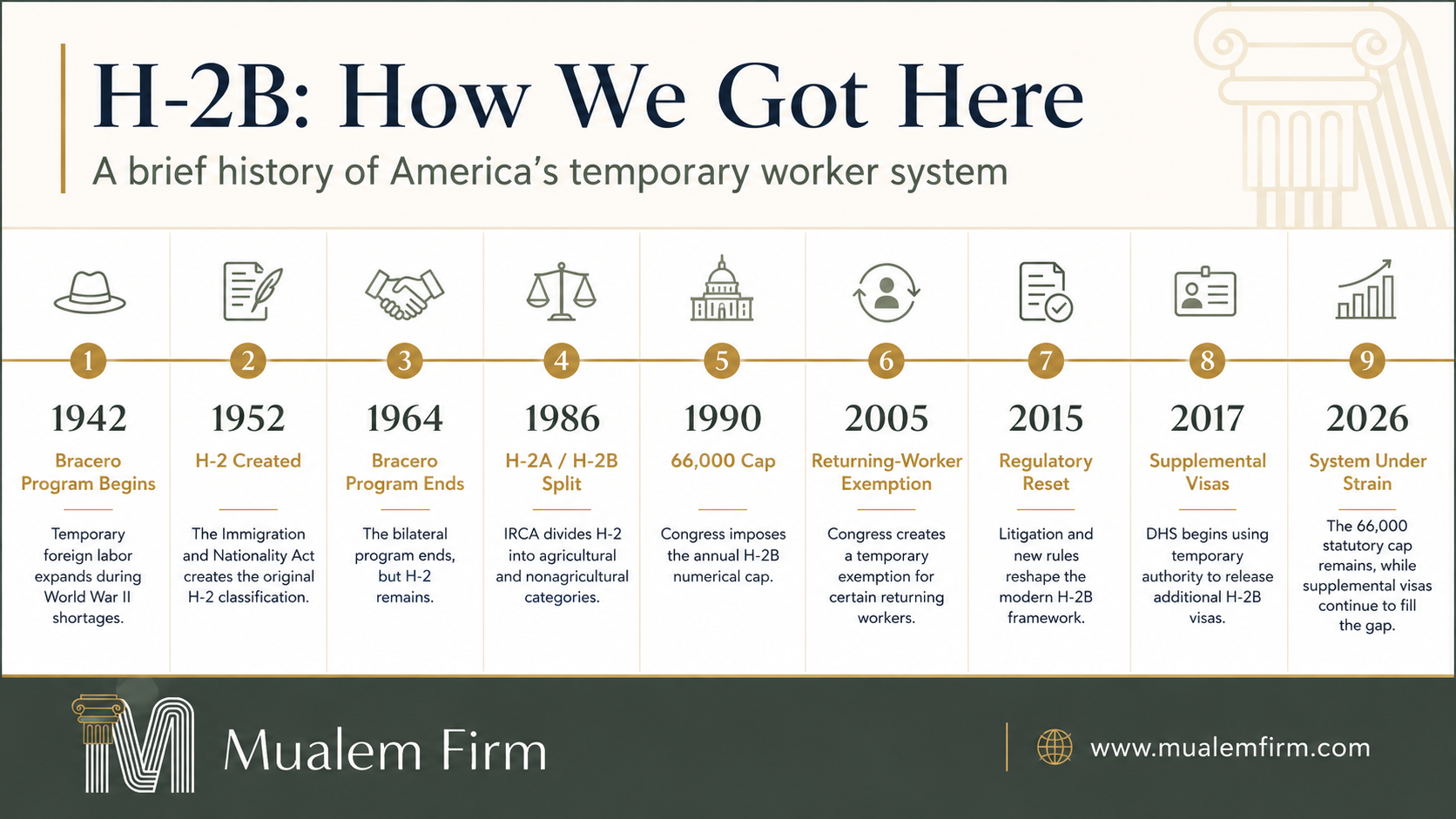
After more than 80 years of temporary-worker policy, the United States has built H-2B layer by layer:
1942: Temporary foreign labor responds to wartime shortages.
1952: Congress creates H-2.
1964: Bracero ends, but H-2 remains.
1986: H-2 splits into H-2A and H-2B.
1990: A numerical ceiling becomes embedded in the system.
2005: Congress turns to returning-worker exemptions.
2008–2015: Litigation and regulatory battles reshape the program.
2015: The modern labor-certification framework emerges.
2017 onward: Supplemental visas become an almost recurring answer to an inadequate permanent cap.
2020s: Randomized filing procedures, changing supplemental allocations, new compliance rules, and annual uncertainty become part of workforce planning.
2026: We are still trying to reconcile a decades-old statutory structure with the workforce needs of a modern economy.
And maybe that is the most important lesson from H-2B history.
The United States has never really debated whether temporary foreign labor has a role in the American economy.
It has used temporary foreign workers in one form or another for generations.
The real debate has always been about how to regulate it.
Who gets access?
How many workers?
Under what conditions?
With what protections?
And how do we ensure American workers are protected while giving legitimate employers access to labor when those workers simply are not available?
After more than eight decades, perhaps the next chapter should not be another temporary exemption, emergency allocation, or one-year fix.
Perhaps it is finally time to ask:
If we were designing a temporary worker program for the American economy of 2026 from scratch, would it look anything like the system we have today?
I suspect the answer is no.
This is the first in a deeper series on the history, evolution, and future of the H-2B program.
Next: Why 66,000? The story behind the H-2B cap and how a decades-old number came to control the workforce planning of thousands of American businesses.
Mualem Firm
Business Immigration | Workforce Strategy
🌐 www.mualemfirm.com
#H2B #ImmigrationLaw #BusinessImmigration #ImmigrationHistory #Workforce #SeasonalBusiness #ImmigrationReform